
 MeshLine
Infrastructure Automation vs Automation Infrastructure: What Is the Difference?
A practical comparison of infrastructure automation and automation infrastructure for teams designing dependable operational systems.
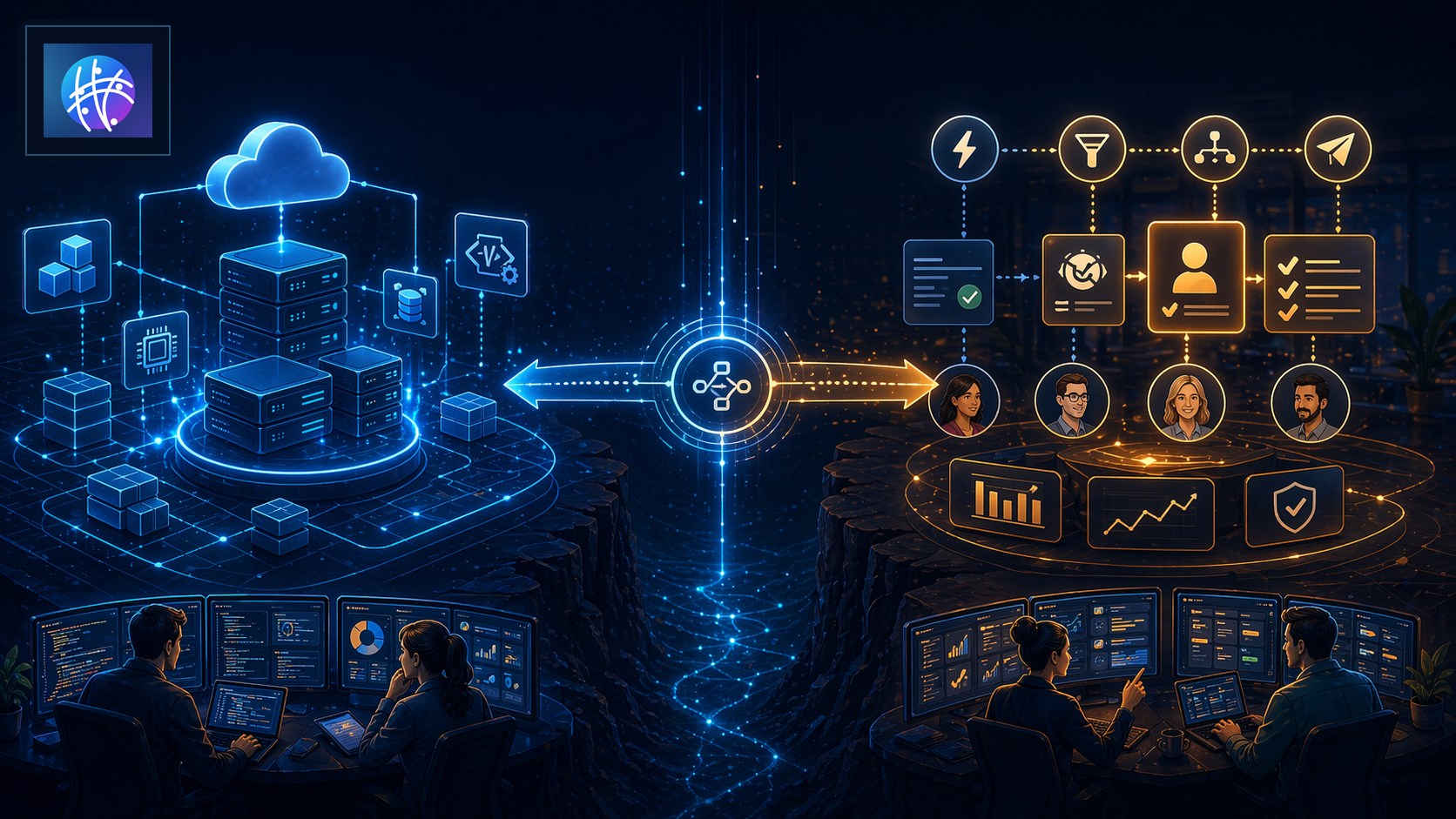
Infrastructure Automation vs Automation Infrastructure: What Is the Difference?
infrastructure automation vs automation infrastructure matters when technical setup starts shaping business execution. The question is not just whether a resource, permission, environment, or deployment can be created automatically. The real question is whether the team can prove who requested it, why it exists, what it affects, how it is monitored, and how it can be recovered when something breaks.
Infrastructure Automation vs Automation Infrastructure: What Is the Difference? in a real operating model
This guide focuses on infrastructure automation vs automation infrastructure, plus infrastructure automation difference, automation infrastructure comparison, automated infrastructure vs operating layer, workflow infrastructure. If a team can provision resources automatically but still cannot explain how business events move through the company, the workflow needs more than speed. It needs a trigger, an owner, an exception path, and an outcome that can be inspected later.
Infrastructure references such as OpenTofu docs, Terraform state, and Pulumi infrastructure as code show how teams can automate the technical foundation. Operators still need to decide what the business trusts that foundation to do. That is where infrastructure automation becomes more than scripting: it becomes part of the operating layer.
Trigger, owner, exception, and outcome
The trigger is technical setup and business workflow execution start depending on each other. A trigger should capture the request once, preserve context, and make the requested change traceable. If the trigger begins in Slack, a ticket, a form, a repo, or a service catalog, the same context should travel through the workflow instead of being retyped at every step.
The owner is platform owners manage environments and access, while operations owners manage workflow execution quality. Infrastructure automation gets risky when ownership is implied instead of encoded. Who approved the setup? Who pays for the resource? Who receives the alert? Who decides whether the change can be rolled back? If those answers are missing, the automation may move faster than the organization can control.
The exception path is the gap appears when resources exist but routing, review, state, and recovery are still manually coordinated. Normal setup should move quickly, but risky setup should pause with a reason, an owner, and enough evidence for a human to decide. The outcome is teams know whether they are automating the technical foundation, the business execution path, or both.
A practical workflow example
Imagine a team can provision resources automatically but still cannot explain how business events move through the company. A surface-level automation creates the resource and sends a confirmation. A production-grade infrastructure automation workflow validates the request, checks policy, applies naming and tagging rules, provisions the resource, connects monitoring, records the owner, and exposes rollback or recovery. Which one would you trust during a launch week?
Here is the operator test: could a new teammate inspect the workflow and understand what happened without asking the person who built it? Could they see request context, approval history, provisioned assets, access scope, monitoring state, cost owner, and recovery notes? If not, the automation is useful, but it is not yet dependable infrastructure.
Three use cases teams can borrow
First, environment setup. A team needs a new staging environment for a client, product line, or workflow. Infrastructure automation should create the environment, attach permissions, configure secrets, connect deployment rules, and create monitoring. The outcome is not "environment created." The outcome is "environment ready for safe work."
Second, access and permissions. A workflow may need service accounts, API scopes, database permissions, or admin roles. The risky version is a person clicking through settings and hoping they remember the change later. The stronger version records who requested access, why the access is needed, when it should expire, and which systems depend on it.
Third, operational monitoring. A new queue, integration, deployment, or AI workflow is not production-ready until the team can see health, latency, errors, and owner escalation. Infrastructure automation should attach observability as part of setup, not as a cleanup chore after customers notice a failure.
Public systems like AWS CDK guide and Azure Bicep overview are useful because they reveal the same pattern: automated change is only valuable when state, policy, and recovery are visible. A fast setup that nobody can inspect becomes another hidden dependency.
Implementation choices that matter
Do not start by asking which tool is best. Start by asking what the automation is allowed to change. Is it creating infrastructure, changing access, deploying code, configuring monitoring, syncing environments, or preparing a workflow for business use? Each change type needs a different level of approval, logging, and rollback.
Next, define the state model. Where does the system record what exists now? Where does it compare desired state to actual state? What happens when someone changes the resource manually? Teams often discover infrastructure automation problems when the tool believes one thing and production reality says another. Drift is not just technical debt. Drift is an operational trust problem.
Finally, decide where human judgment belongs. Humans should not be forwarding routine setup steps, but they should review cost spikes, risky permissions, production-impacting changes, and ambiguous ownership. Good infrastructure automation removes repetitive coordination while preserving judgment where risk is real.
What breaks first in production
The first failure mode is unowned infrastructure. Resources keep running after the workflow, client, campaign, or experiment ends. Nobody knows whether they are safe to remove, so the business pays for confusion.
The second failure mode is permission drift. A temporary admin role, broad API scope, or copied credential becomes permanent because the setup path never encoded expiration or review. That is how a convenience shortcut becomes a governance problem.
The third failure mode is silent operational failure. The setup works once, but monitoring was skipped, logs are scattered, and no owner receives the alert. The team finds out through a customer ticket, a broken report, or a launch delay.
Rollout pattern
Start with one repeatable setup workflow. Map the request, approval, provisioning steps, validation checks, monitoring requirements, owner fields, and rollback path. Keep the first version narrow enough to inspect by hand.
Then run the workflow against real cases. Pull five completed setups and ask: did the automation reduce manual work, make ownership clearer, improve recovery, and preserve evidence? If the answer is no, add controls before expanding scope.
Once the pattern works, turn it into a reusable operating path. The goal is not to automate every edge case immediately. The goal is to make common setup safer, faster, and easier to reason about.
Where Meshline fits
Meshline fits when infrastructure automation vs automation infrastructure needs to connect technical setup to business workflow execution. Meshline is Autonomous Operations Infrastructure for trigger-to-outcome execution, ownership and control, and system-led execution. The category shift is simple: infrastructure should not stop at provisioning. It should help the business understand whether the workflow is ready to operate.
Teams working with event routing console, orchestration, workflow orchestrator can use the same operating model across technical setup and business execution. That is how lean teams avoid two disconnected worlds: one where infrastructure is created and another where operators manually figure out whether work can move.
QA checklist before rollout
- Is the request trigger captured with enough context?
- Is there a named owner for cost, access, monitoring, and recovery?
- Are approval rules different for low-risk and high-risk changes?
- Can the team compare desired state to actual state?
- Are logs, alerts, and rollback paths created with the resource?
- Does every exception route to a visible owner instead of a hidden chat thread?
- Can leadership tell whether automation reduced setup time, drift, and operational cleanup?
Final takeaway
infrastructure automation vs automation infrastructure is not just a way to set things up faster. It is a way to make setup repeatable, explainable, and recoverable. Pick one workflow that keeps creating manual setup work, define the trigger-to-outcome path, and automate the controls before scaling the volume.